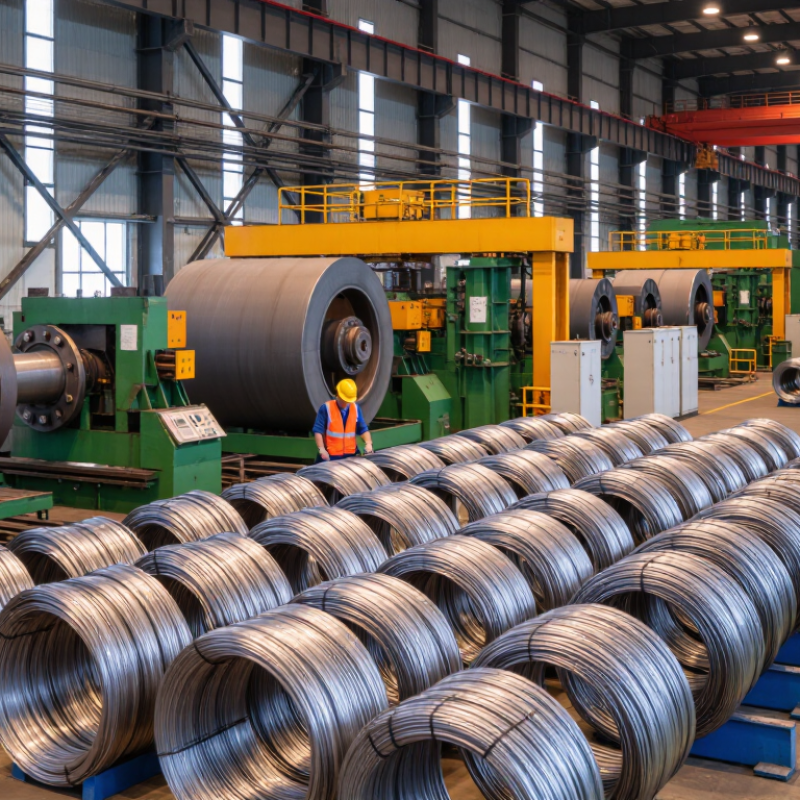
| 1 | Product Diameter Range | Common commercial wire-rod sizes include approximately 5.5–16 mm in diameter. Some mills supply smaller or larger sizes depending on rolling equipment and product grade. | The correct diameter reduces downstream drawing passes, material loss and tooling adjustments. | Product catalogue, dimensional range, mill capability statement and sample inspection report. |
| 2 | Applicable Product Standards | Common reference standards include ASTM A510/A510M, EN 10016, ISO 16120 and JIS G3505/G3506. The applicable standard must match the ordered steel grade and end use. | Standards define requirements for chemical composition, dimensions, mechanical properties, testing and surface quality. | Purchase specification, standard edition, certificate of conformity and third-party test comparison where required. |
| 3 | Chemical Composition Control | Typical reported elements include carbon, manganese, silicon, sulfur and phosphorus. Alloy grades may also specify chromium, nickel, molybdenum, boron or other elements. | Chemistry affects strength, ductility, weldability, drawability, heat-treatment response and corrosion performance. | Heat analysis, product analysis, spectrometer records and a comparison between specified limits and actual values. |
| 4 | Dimensional Tolerance and Ovality | Diameter tolerance and ovality are grade-, size- and standard-dependent. Acceptance should be based on the tolerance stated in the purchase order rather than on a universal value. | Stable dimensions improve drawing speed, reduce die wear and help maintain consistent final wire dimensions. | Calibration records, dimensional inspection data, coil sampling plan and actual measurements at multiple positions. |
| 5 | Mechanical Properties | Relevant properties may include tensile strength, yield strength, elongation and reduction of area. Required values vary significantly by carbon level, alloy design, diameter and delivery condition. | Mechanical consistency determines whether the rod can be drawn, formed, welded or heat-treated without excessive breakage. | Tensile-test results, sampling frequency, test temperature, test method and batch-to-batch statistical records. |
| 6 | Surface Quality | Wire rod should be checked for defects such as seams, laps, cracks, slivers, excessive scale and harmful rolled-in imperfections. The permitted condition depends on the applicable standard and end use. | Surface defects can become fracture points during drawing, galvanizing, welding or cold forming. | Visual inspection procedure, surface-defect acceptance criteria, descaling or pickling requirements and inspection photographs. |
| 7 | Coil Weight and Packaging | Commercial coil weights commonly fall around 1–2.5 metric tons, although the actual range depends on the mill, diameter and handling system. Coils should be secured and protected against transport damage and contamination. | Coil weight affects unloading equipment, storage capacity, production line compatibility and handling cost. | Coil-weight tolerance, inner and outer diameter, coil height, banding method, labels and moisture-protection details. |
| 8 | Traceability and Inspection Documents | A complete traceability system should connect each coil to its heat number, production date, grade, dimensions and test results. EN 10204 Type 3.1 inspection certificates are commonly requested for controlled industrial supply. | Traceability supports incoming inspection, nonconformance analysis, regulatory compliance and customer audits. | Sample mill test certificate, heat-number marking, packing list, inspection plan and certificate-verification process. |
| 9 | Production Consistency and Supply Capability | Compare recent delivery records, repeat-order performance, capacity allocation, production scheduling and the supplier’s ability to maintain the same grade and dimensions over time. | Consistent supply is essential for continuous drawing, fastener, welding and construction-material production. | Twelve-month delivery history, production lead-time commitment, capacity statement, contingency plan and quality-performance data. |
| 10 | Total Landed Cost and Technical Support | Evaluate more than the quoted metric-ton price. Include freight, packaging, inspection, tariffs, payment terms, yield loss, rejection risk and technical support. | A lower purchase price may be offset by higher processing loss, inconsistent quality, delayed delivery or additional inspection costs. | Itemized quotation, shipping terms, sample approval plan, complaint-response time, replacement policy and total-cost calculation. |